Emergency Light Inspection London
Certified 3-Hour Discharge & BS 5266 Testing from £140
Ensure absolute statutory compliance with the Regulatory Reform (Fire Safety) Order 2005 and British Standard BS 5266-1 with an accredited Emergency Light Inspection London survey conducted by CertiVest London. Fully certified NICEIC and ECA registered electrical testing engineers carrying out comprehensive annual 3-hour discharge tests, monthly flick switch functional checks, luminaire battery pack diagnostics, and escape route lux level auditing across commercial offices, residential blocks, retail venues, and industrial sites across all 32 London boroughs with guaranteed 24–48h digital certificates and statutory fire logbook sign-offs.
- NICEIC & ECA Qualified Electrical Engineers
- Full BS 5266-1 3-Hour Discharge & Photometric Lux Audits
- Digital Certificate & Statutory Fire Logbook Sign-Off
Legal Obligations for an Emergency Light Inspection London
Under the Regulatory Reform (Fire Safety) Order 2005 (RRO), BS 5266-1 (Emergency Lighting Code of Practice), and BS EN 50172, employers, commercial landlords, managing agents, and designated “Responsible Persons” in London have an absolute legal duty to install, inspect, and maintain emergency escape lighting systems in full operating condition.
Monthly Short-Duration Functional Check (‘Flick Test’)
Mandatory monthly operational test designed to simulate a localized mains power failure without draining the battery reserve, ensuring prompt activation:
- Mains Failure Simulation: Isolation via dedicated fish-key test switches or automated test regimes.
- Illumination Check: Visual verification that every luminaire and illuminated exit sign strikes instantly.
- Restoration Verification: Checking that normal supply restores and charging indicator LEDs illuminate green.
- Logbook Registration: Immediate signed documentation in the on-site statutory fire logbook.
Annual 3-Hour Full Duration Discharge Audit
Comprehensive annual engineering survey requiring full system isolation to test emergency autonomy across the statutory battery duration:
- Continuous 3-Hour Run: Continuous operation test confirming batteries sustain required lumen output for 180 minutes.
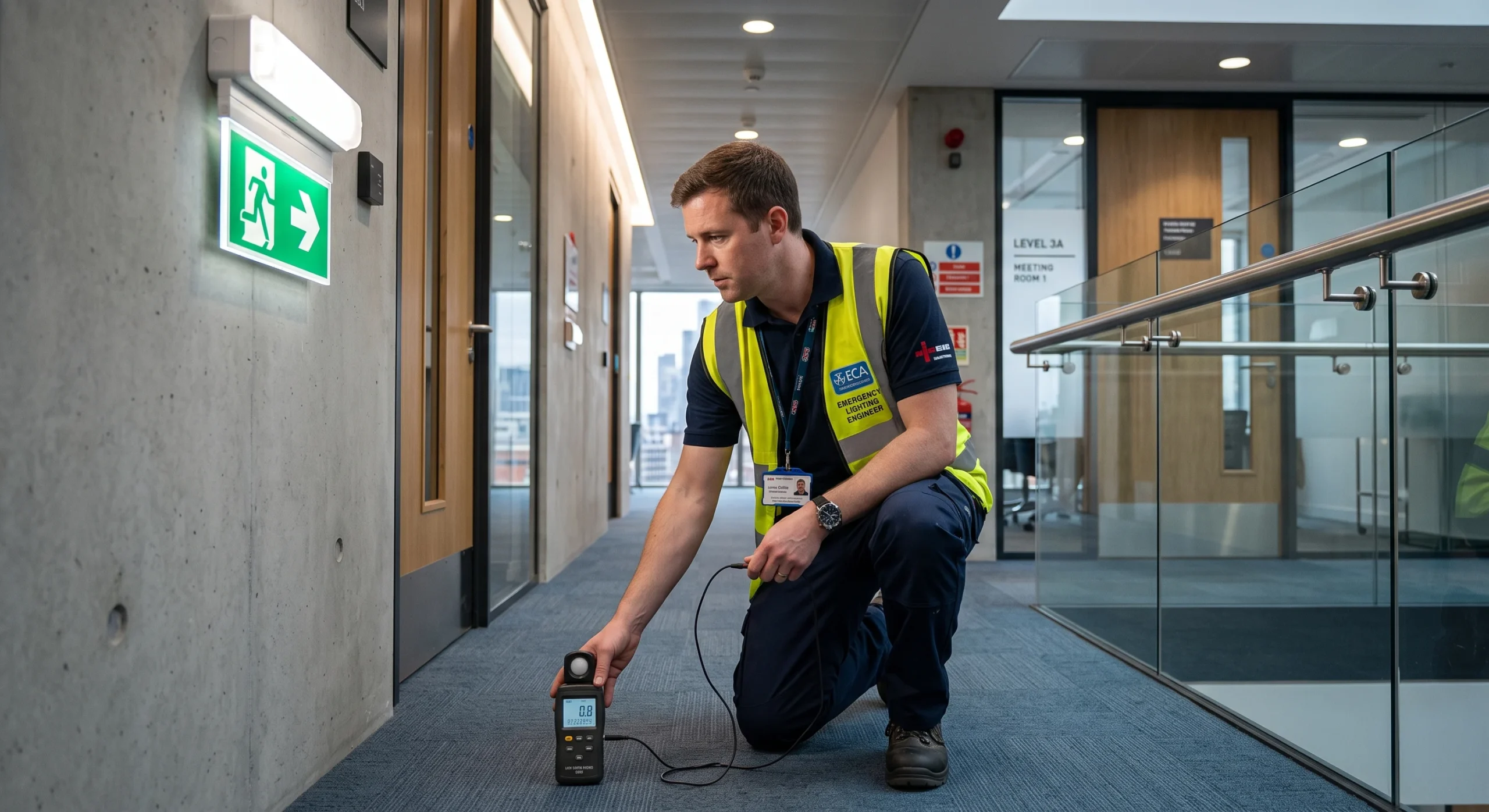
- Escape Route Lux Measurement: Calibrated photometer audit verifying minimum 1.0 Lux along the central escape path.
- Component Diagnostics: Identifying dead battery cells, weeping electrolytes, and failed LED arrays.
- Certification Lodgement: Issuance of the official digital BS 5266-1 Periodic Inspection Certificate.

Secret Key Switch Testing, Lithium Batteries & Central Battery Systems
Emergency luminaires must never be tested by turning off entire distribution board circuits, which compromises security and occupant safety. CertiVest London qualified engineers utilize specialized secret fish-keys to isolate test switches without disrupting normal business operations. We inspect internal battery chemistries (NiCd, NiMH, and modern LiFePO4 cells), test high-capacity Central Battery Systems (CBS), and calibrate Automatic Test Systems (ATS) for DALI networks.
Enforcement Action, Fire Authority Fines & Insurance Repudiation
Under Article 17 of the Regulatory Reform (Fire Safety) Order 2005, failure to maintain emergency escape lighting systems in efficient working order constitutes a criminal offense. London Fire Brigade (LFB) inspecting officers routinely request the emergency lighting logbook and the annual 3-hour discharge certificate during audits. Missing or failed certificates result in Article 30 Prohibition Notices, unlimited financial penalties, and immediate repudiation of insurance coverage after an incident. Review official workplace guidance on the GOV.UK Workplace Fire Safety Guidance Portal.
Managing full commercial safety compliance? Integrate your lighting testing with our certified Commercial Fire Risk Assessment (FRA) London, inspect escape barriers with our Fire Door Inspection London service, or audit wiring infrastructure via our Commercial EICR Inspection London.
What Is Checked During an Emergency Light Inspection London Survey?
A certified Emergency Light Inspection London survey conducted by CertiVest London follows an exhaustive technical procedure on every self-contained luminaire, illuminated exit sign, and central battery inverter—evaluating 3-hour battery capacity, escape route lux levels, automated test systems, and statutory fire logbooks.
1. 3-Hour Autonomy & Discharge
Simulating a prolonged electrical blackout to confirm every internal battery pack sustains compliant lumen output for 180 continuous minutes, identifying failing cells that drop out prematurely.
2. Photometric Lux Levels
Precision calibrated photometer audit verifying statutory illumination: minimum 1.0 Lux along the central line of escape corridors and minimum 0.5 Lux in open anti-panic floor zones.
3. Illuminated Exit Signage
Inspecting directional ‘Running Man’ escape route signs (BS 5499 & ISO 7010) for uniform surface luminance, contrast, clear line of sight, and non-obscured placement above fire exits.
4. Batteries & LED Drivers
Checking internal battery chemistry integrity (lithium iron phosphate, nickel-cadmium, sealed lead-acid), verifying charging circuits, inverter electronics, and solid-state LED driver operation.
5. Secret Key Switches & DALI ATS
Auditing localized secret fish-key test points to ensure proper circuit segregation without cutting mains power, alongside configuring and interrogating digital DALI Automated Test Systems.
6. Logbook Audit & Asset Register
Reviewing on-site statutory testing records, updating physical fire safety logbooks, and barcoding every luminaire into a digital asset schedule complete with pass/fail markers and remedial actions.

Photometric Lux Auditing: 1 Lux Escape Routes & 0.5 Lux Anti-Panic Areas
In a smoke-filled or pitch-black evacuation, insufficient light levels cause panic and severe injury. Under BS EN 1838, emergency escape routes must achieve a minimum of 1.0 Lux along their central core, stairwells require precise tread-edge visibility, and open spaces exceeding 60m² require a minimum of 0.5 Lux anti-panic illumination. CertiVest London engineers utilize calibrated digital photometers to map emergency light distribution across complex commercial architectures.
Governing British & European Emergency Lighting Standards
Every commercial, residential, and industrial emergency lighting survey conducted by CertiVest adheres strictly to statutory frameworks:
Emergency Lighting Design & Maintenance
Primary UK standard governing design, installation, periodic testing, and certification of emergency escape lighting.
Lighting Applications & Illumination Values
Mandatory luminous requirements specifying minimum lux levels along escape corridors, stairs, and call points.
Escape Lighting Testing & Record Keeping
Prescribes monthly flick test regimes, annual full duration discharge procedures, and statutory fire logbook duties.
IET Wiring Regulations (18th Edition)
Ensures supply cable fire-survival integrity, circuit segregation, isolation devices, and surge protection compliance.
What Is Checked During an Emergency Light Inspection London Survey?
A certified Emergency Light Inspection London survey conducted by CertiVest London follows an exhaustive technical procedure on every self-contained luminaire, illuminated exit sign, and central battery inverter—evaluating 3-hour battery capacity, escape route lux levels, automated test systems, and statutory fire logbooks.
1. 3-Hour Autonomy & Discharge
Simulating a prolonged electrical blackout to confirm every internal battery pack sustains compliant lumen output for 180 continuous minutes, identifying failing cells that drop out prematurely.
2. Photometric Lux Levels
Precision calibrated photometer audit verifying statutory illumination: minimum 1.0 Lux along the central line of escape corridors and minimum 0.5 Lux in open anti-panic floor zones.
3. Illuminated Exit Signage
Inspecting directional ‘Running Man’ escape route signs (BS 5499 & ISO 7010) for uniform surface luminance, contrast, clear line of sight, and non-obscured placement above fire exits.
4. Batteries & LED Drivers
Checking internal battery chemistry integrity (lithium iron phosphate, nickel-cadmium, sealed lead-acid), verifying charging circuits, inverter electronics, and solid-state LED driver operation.
5. Secret Key Switches & DALI ATS
Auditing localized secret fish-key test points to ensure proper circuit segregation without cutting mains power, alongside configuring and interrogating digital DALI Automated Test Systems.
6. Logbook Audit & Asset Register
Reviewing on-site statutory testing records, updating physical fire safety logbooks, and barcoding every luminaire into a digital asset schedule complete with pass/fail markers and remedial actions.
Photometric Lux Auditing: 1 Lux Escape Routes & 0.5 Lux Anti-Panic Areas
In a smoke-filled or pitch-black evacuation, insufficient light levels cause panic and severe injury. Under BS EN 1838, emergency escape routes must achieve a minimum of 1.0 Lux along their central core, stairwells require precise tread-edge visibility, and open spaces exceeding 60m² require a minimum of 0.5 Lux anti-panic illumination. CertiVest London engineers utilize calibrated digital photometers to map emergency light distribution across complex commercial architectures.
Governing British & European Emergency Lighting Standards
Every commercial, residential, and industrial emergency lighting survey conducted by CertiVest adheres strictly to statutory frameworks:
Emergency Lighting Design & Maintenance
Primary UK standard governing design, installation, periodic testing, and certification of emergency escape lighting.
Lighting Applications & Illumination Values
Mandatory luminous requirements specifying minimum lux levels along escape corridors, stairs, and call points.
Escape Lighting Testing & Record Keeping
Prescribes monthly flick test regimes, annual full duration discharge procedures, and statutory fire logbook duties.
IET Wiring Regulations (18th Edition)
Ensures supply cable fire-survival integrity, circuit segregation, isolation devices, and surge protection compliance.
Fixed Emergency Light Inspection London Pricing & Package Tiers
Transparent, fixed-fee testing rates for retail stores, corporate commercial offices, residential blocks, and healthcare facilities from CertiVest London. Fully certified Emergency Light Inspection London audits conducted by NICEIC and ECA registered engineers with zero hidden callout fees and fast 24–48h digital certificate issuance.
Digital BS 5266 Compliance Certificate & Statutory Fire Logbook Sign-Off
Every testing survey concludes with an official digital BS 5266-1 Periodic Inspection Certificate. Each emergency luminaire, illuminated escape sign, and central battery inverter is inventoried in a comprehensive asset schedule detailing test duration, individual battery health, lux levels, and pass/fail statuses, accompanied by an on-site signature in your statutory building fire logbook.

Small Premises / Retail (Up to 10 Units)
- Up to 10 emergency luminaires / exit signs
- Retail shops, small offices, cafes
- Full 3-hour discharge or functional test
- Digital BS 5266 certificate & logbook update
Medium Block / Office (Up to 25 Units)
- Up to 25 emergency fittings surveyed
- Multi-storey offices, communal corridors
- Key switch isolation & battery cell check
- Prioritised remedial action plan included
Large Complex / Portfolio (26+ Units)
- Over 26 fittings across commercial estates
- Central Battery Systems (CBS) & DALI ATS
- Annual maintenance & monthly flick contracts
- Dedicated London accounts engineer
Book Your Official Emergency Light Survey with CertiVest London
Submit your premises details below. Our London fire compliance team will review your estimated luminaire count, circuit configuration, and access requirements to confirm an accredited electrical engineer within 60 minutes.